An insider view — from the other side of the table.
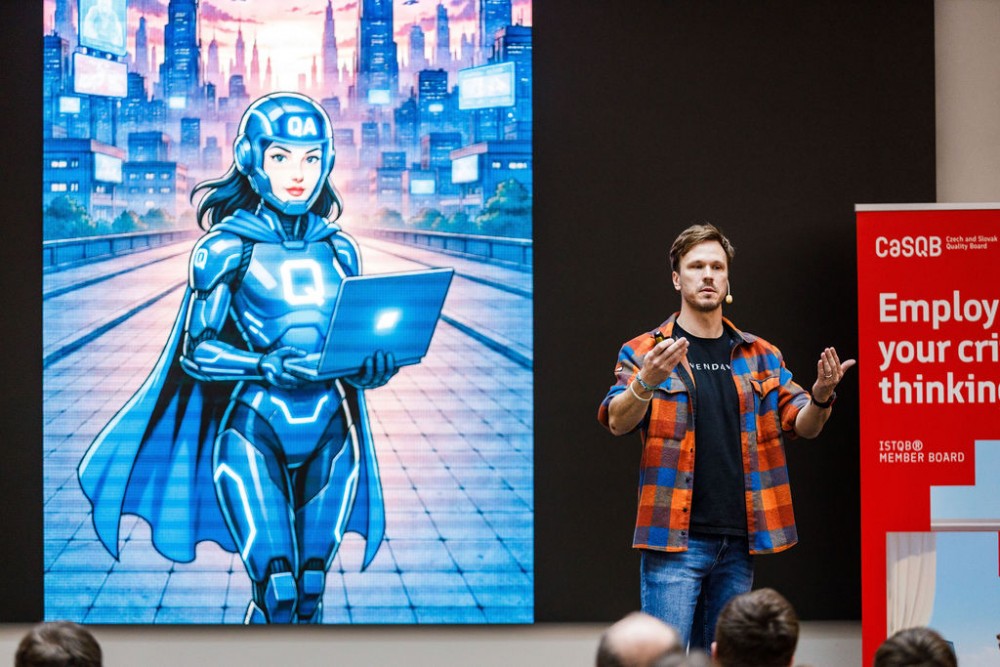
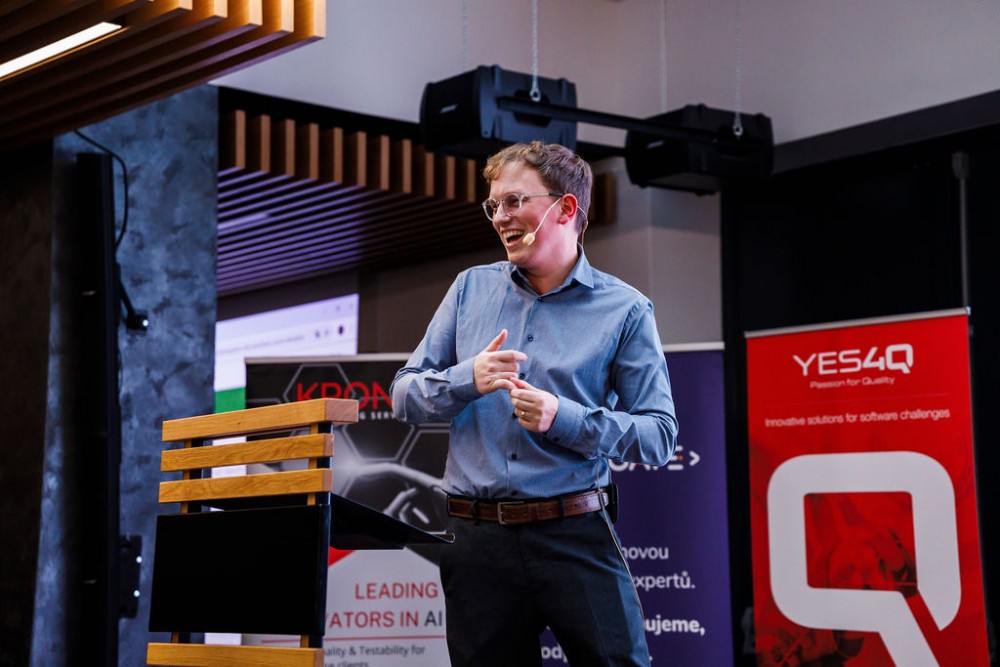
Three years ago, Robin Weiss stood on this same TestCrunch stage as a QA Manager. This year he returned — in a different role. As a Product Manager at Vendavo. As someone for whom QA isn't a colleague but a partner. And as someone who noticed something unsettling.
"The testers stopped calling," said host Jiří Charvát in his introduction. "As every parent knows — you raise them, and then they stop picking up the phone."
Before diving in, Robin proposed a brief ritual. Five seconds of silence — for the QA professional who first convinced a developer that a defect is a defect, not an intende feature. "This person recently left this world. Chuck Norris."
Laughter in the room. Then four problems that slowly quieted it.
Problem #1: Loss of Context — How We Lost Klára
Robin described a world the room knew well: on one side, manual QA — analysts, contextual knowledge, the product manager's sparring partner. On the other, automation QA — efficiency, frameworks, speed.
"The world was roughly in balance. Then AI arrived."
The conversation about what to test and why quietly disappeared. In its place: discussions about frameworks, agents, implementations. Automation QA has a natural affinity for AI — and gets the opportunities, the attention, the budget. The contextual, business-oriented side of QA fades away.
Robin illustrated this with a concrete story. Klára — one of the best QA professionals he's ever worked with. Someone who came to every refinement session with a prepared list of questions, analysed the impact on the entire system, and regularly sent the product manager back to the customer with the message that the brief simply didn't make sense.
"She made me happy. I always thought I came prepared. Often I wasn't."
And today? The team went from nine QAs to four. Klára can't keep up. She arrives at refinement sessions unprepared, with no time to review the brief, no time to push back. And Robin? "I feel great. Nobody has any questions. It seems like AI has made the whole process smoother."
Except it hasn't. There's just nobody left to tell him otherwise.
Problem #2: The Junior Crisis — A Broken Chain
Few in the room admitted their company had hired a junior in the past six months. Weiss wasn't surprised.
Why would companies hire juniors? The reason used to be clear: regression testing, backlog triage, bug verification. Today a senior with AI tools does it in a fraction of the time. The junior-level work has vanished — and with it, the reason to hire juniors.
But this breaks the natural chain: junior → mid → senior → mentor. "The half-life of any engineer is somewhere between two and five years. People leave — you can't stop that. And when they go, they take their knowledge with them. Who replaces them?"
Companies saving money on juniors today will be asking where all the seniors went in a few
years.
Problem #3: Shift-Right — Back to Where We Started
Klára has no time. There are no juniors. So who tests on the left? Who stops and tells the product manager that the brief doesn't make sense?
Nobody. And so — paradoxically — in the era of the greatest test automation in history, we're drifting back to reactive testing at the end of the cycle.
"Shift-right. I think that's where we're slowly heading."
Problem #4: Loss of Control — Who's Reading the Fifteen-Page Document?
AI generates enormous volumes of content. Tests, scenarios, architectural documents, specifications. And nobody reads them.
Robin described a situation from his own practice: an architect takes his epic, runs it through AI, and produces a fifteen-page architectural proposal. "I don't read it. I can't. The headings look fine, it roughly makes sense — I approve it."
Based on that approval, it gets implemented. Based on the implementation, tests are generated. And the mistake that originated in the poorly thought-through brief propagates through the entire process — all the way to production.
"And then the whole thing gets documented using AI as well. That's your recipe for a proper disaster."
The Closing Argument: Convince the Decision-Makers
"The biggest threat isn't that AI will replace us. It's that we'll rest on our laurels assuming it can't."
The happy manager who reduced five QAs to two and got a bonus for the savings isn't looking beyond the next fiscal quarter. QA professionals need to speak that language — and make their case before it's too late.
 Petr Neugebauer